# First Steps { #first-steps }
The simplest FastAPI file could look like this:
{* ../../docs_src/first_steps/tutorial001_py39.py *}
Copy that to a file `main.py`.
Run the live server:
```console
$ fastapi dev main.py
FastAPI Starting development server 🚀
Searching for package file structure from directories
with __init__.py files
Importing from /home/user/code/awesomeapp
module 🐍 main.py
code Importing the FastAPI app object from the module with
the following code:
from main import app
app Using import string: main:app
server Server started at http://127.0.0.1:8000
server Documentation at http://127.0.0.1:8000/docs
tip Running in development mode, for production use:
fastapi run
Logs:
INFO Will watch for changes in these directories:
['/home/user/code/awesomeapp']
INFO Uvicorn running on http://127.0.0.1:8000 (Press CTRL+C
to quit)
INFO Started reloader process [383138] using WatchFiles
INFO Started server process [383153]
INFO Waiting for application startup.
INFO Application startup complete.
```
In the output, there's a line with something like:
```hl_lines="4"
INFO: Uvicorn running on http://127.0.0.1:8000 (Press CTRL+C to quit)
```
That line shows the URL where your app is being served on your local machine.
### Check it { #check-it }
Open your browser at http://127.0.0.1:8000.
You will see the JSON response as:
```JSON
{"message": "Hello World"}
```
### Interactive API docs { #interactive-api-docs }
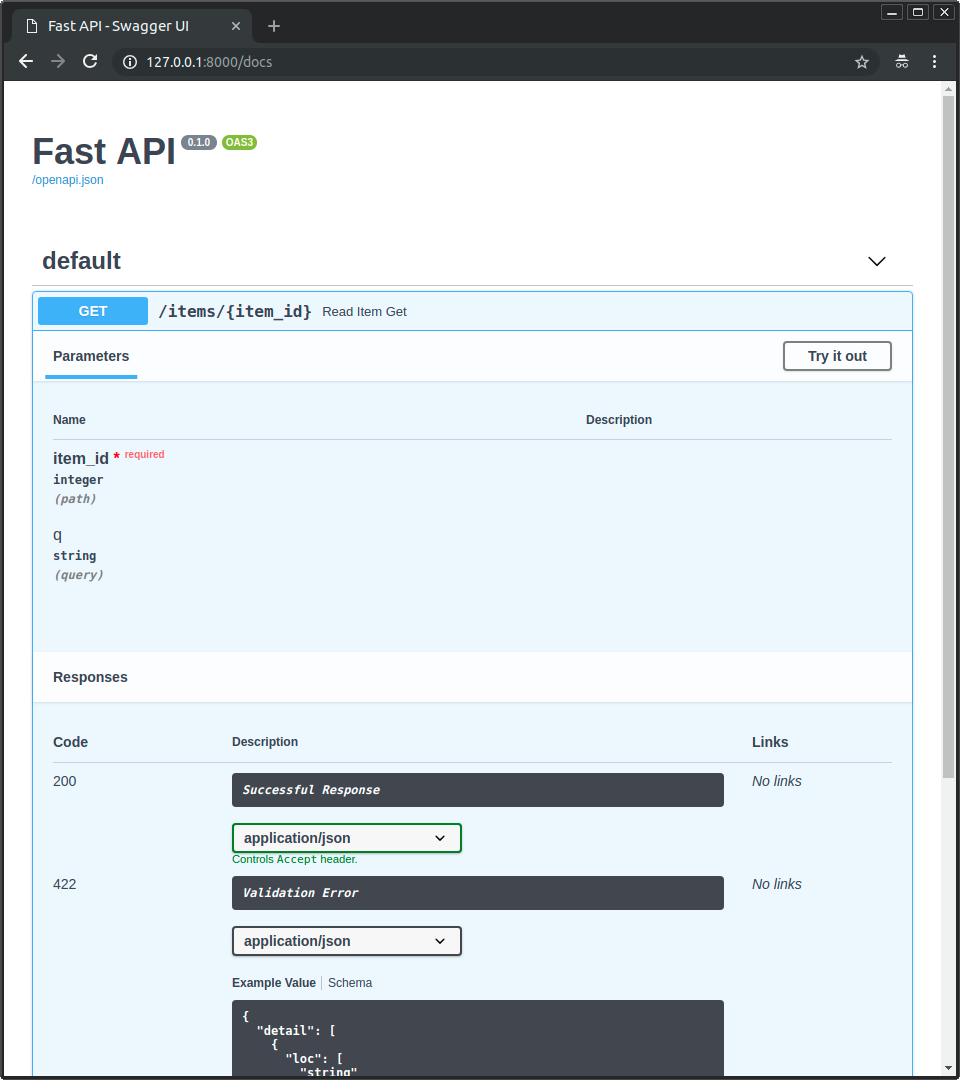
Now go to http://127.0.0.1:8000/docs.
You will see the automatic interactive API documentation (provided by Swagger UI):
### Alternative API docs { #alternative-api-docs }
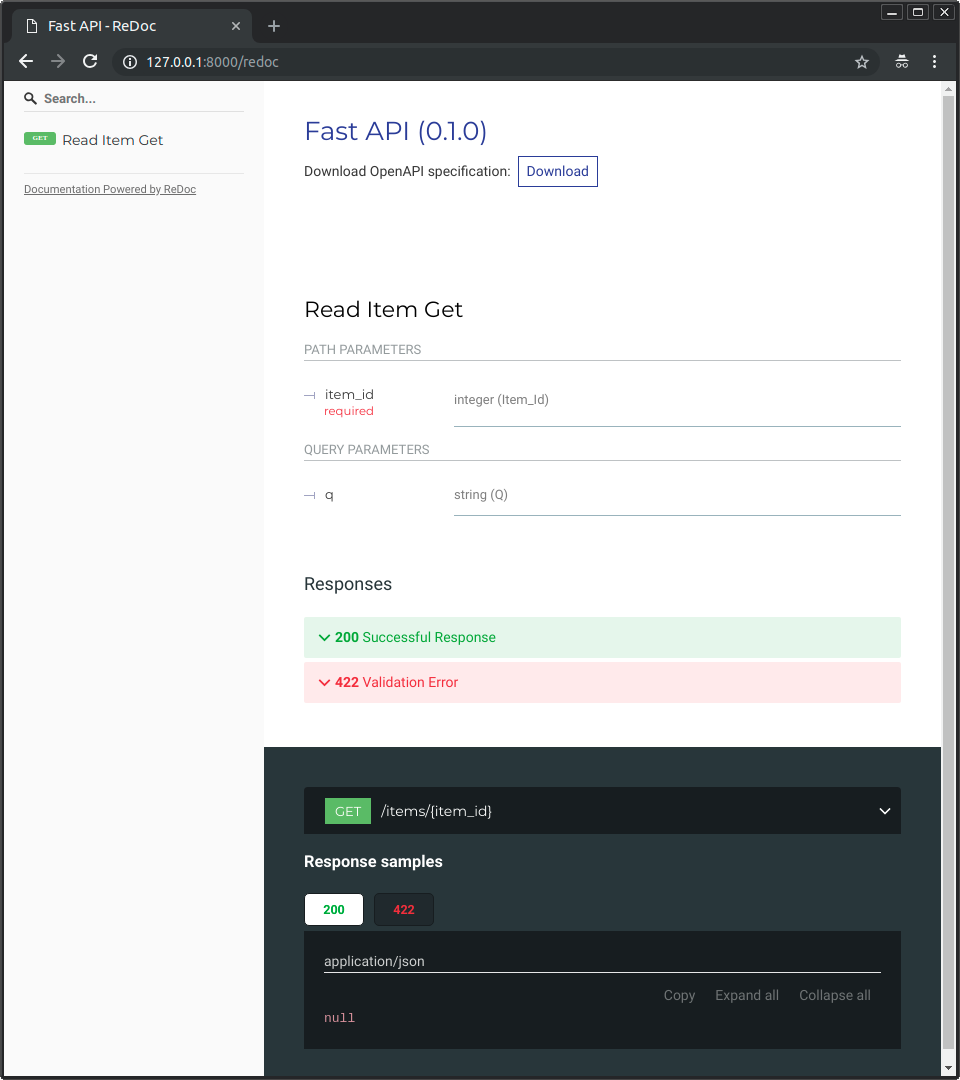
And now, go to http://127.0.0.1:8000/redoc.
You will see the alternative automatic documentation (provided by ReDoc):
### OpenAPI { #openapi }
**FastAPI** generates a "schema" with all your API using the **OpenAPI** standard for defining APIs.
#### "Schema" { #schema }
A "schema" is a definition or description of something. Not the code that implements it, but just an abstract description.
#### API "schema" { #api-schema }
In this case, OpenAPI is a specification that dictates how to define a schema of your API.
This schema definition includes your API paths, the possible parameters they take, etc.
#### Data "schema" { #data-schema }
The term "schema" might also refer to the shape of some data, like a JSON content.
In that case, it would mean the JSON attributes, and data types they have, etc.
#### OpenAPI and JSON Schema { #openapi-and-json-schema }
OpenAPI defines an API schema for your API. And that schema includes definitions (or "schemas") of the data sent and received by your API using **JSON Schema**, the standard for JSON data schemas.
#### Check the `openapi.json` { #check-the-openapi-json }
If you are curious about how the raw OpenAPI schema looks like, FastAPI automatically generates a JSON (schema) with the descriptions of all your API.
You can see it directly at: http://127.0.0.1:8000/openapi.json.
It will show a JSON starting with something like:
```JSON
{
"openapi": "3.1.0",
"info": {
"title": "FastAPI",
"version": "0.1.0"
},
"paths": {
"/items/": {
"get": {
"responses": {
"200": {
"description": "Successful Response",
"content": {
"application/json": {
...
```
#### What is OpenAPI for { #what-is-openapi-for }
The OpenAPI schema is what powers the two interactive documentation systems included.
And there are dozens of alternatives, all based on OpenAPI. You could easily add any of those alternatives to your application built with **FastAPI**.
You could also use it to generate code automatically, for clients that communicate with your API. For example, frontend, mobile or IoT applications.
### Deploy your app (optional) { #deploy-your-app-optional }
You can optionally deploy your FastAPI app to FastAPI Cloud, go and join the waiting list if you haven't. 🚀
If you already have a **FastAPI Cloud** account (we invited you from the waiting list 😉), you can deploy your application with one command.
Before deploying, make sure you are logged in:
```console
$ fastapi login
You are logged in to FastAPI Cloud 🚀
```
Then deploy your app:
```console
$ fastapi deploy
Deploying to FastAPI Cloud...
✅ Deployment successful!
🐔 Ready the chicken! Your app is ready at https://myapp.fastapicloud.dev
```
That's it! Now you can access your app at that URL. ✨
## Recap, step by step { #recap-step-by-step }
### Step 1: import `FastAPI` { #step-1-import-fastapi }
{* ../../docs_src/first_steps/tutorial001_py39.py hl[1] *}
`FastAPI` is a Python class that provides all the functionality for your API.
/// note | Technical Details
`FastAPI` is a class that inherits directly from `Starlette`.
You can use all the Starlette functionality with `FastAPI` too.
///
### Step 2: create a `FastAPI` "instance" { #step-2-create-a-fastapi-instance }
{* ../../docs_src/first_steps/tutorial001_py39.py hl[3] *}
Here the `app` variable will be an "instance" of the class `FastAPI`.
This will be the main point of interaction to create all your API.
### Step 3: create a *path operation* { #step-3-create-a-path-operation }
#### Path { #path }
"Path" here refers to the last part of the URL starting from the first `/`.
So, in a URL like:
```
https://example.com/items/foo
```
...the path would be:
```
/items/foo
```
/// info
A "path" is also commonly called an "endpoint" or a "route".
///
While building an API, the "path" is the main way to separate "concerns" and "resources".
#### Operation { #operation }
"Operation" here refers to one of the HTTP "methods".
One of:
* `POST`
* `GET`
* `PUT`
* `DELETE`
...and the more exotic ones:
* `OPTIONS`
* `HEAD`
* `PATCH`
* `TRACE`
In the HTTP protocol, you can communicate to each path using one (or more) of these "methods".
---
When building APIs, you normally use these specific HTTP methods to perform a specific action.
Normally you use:
* `POST`: to create data.
* `GET`: to read data.
* `PUT`: to update data.
* `DELETE`: to delete data.
So, in OpenAPI, each of the HTTP methods is called an "operation".
We are going to call them "**operations**" too.
#### Define a *path operation decorator* { #define-a-path-operation-decorator }
{* ../../docs_src/first_steps/tutorial001_py39.py hl[6] *}
The `@app.get("/")` tells **FastAPI** that the function right below is in charge of handling requests that go to:
* the path `/`
* using a get operation
/// info | `@decorator` Info
That `@something` syntax in Python is called a "decorator".
You put it on top of a function. Like a pretty decorative hat (I guess that's where the term came from).
A "decorator" takes the function below and does something with it.
In our case, this decorator tells **FastAPI** that the function below corresponds to the **path** `/` with an **operation** `get`.
It is the "**path operation decorator**".
///
You can also use the other operations:
* `@app.post()`
* `@app.put()`
* `@app.delete()`
And the more exotic ones:
* `@app.options()`
* `@app.head()`
* `@app.patch()`
* `@app.trace()`
/// tip
You are free to use each operation (HTTP method) as you wish.
**FastAPI** doesn't enforce any specific meaning.
The information here is presented as a guideline, not a requirement.
For example, when using GraphQL you normally perform all the actions using only `POST` operations.
///
### Step 4: define the **path operation function** { #step-4-define-the-path-operation-function }
This is our "**path operation function**":
* **path**: is `/`.
* **operation**: is `get`.
* **function**: is the function below the "decorator" (below `@app.get("/")`).
{* ../../docs_src/first_steps/tutorial001_py39.py hl[7] *}
This is a Python function.
It will be called by **FastAPI** whenever it receives a request to the URL "`/`" using a `GET` operation.
In this case, it is an `async` function.
---
You could also define it as a normal function instead of `async def`:
{* ../../docs_src/first_steps/tutorial003_py39.py hl[7] *}
/// note
If you don't know the difference, check the [Async: *"In a hurry?"*](../async.md#in-a-hurry){.internal-link target=_blank}.
///
### Step 5: return the content { #step-5-return-the-content }
{* ../../docs_src/first_steps/tutorial001_py39.py hl[8] *}
You can return a `dict`, `list`, singular values as `str`, `int`, etc.
You can also return Pydantic models (you'll see more about that later).
There are many other objects and models that will be automatically converted to JSON (including ORMs, etc). Try using your favorite ones, it's highly probable that they are already supported.
### Step 6: Deploy it { #step-6-deploy-it }
Deploy your app to **FastAPI Cloud** with one command: `fastapi deploy`. 🎉
#### About FastAPI Cloud { #about-fastapi-cloud }
**FastAPI Cloud** is built by the same author and team behind **FastAPI**.
It streamlines the process of **building**, **deploying**, and **accessing** an API with minimal effort.
It brings the same **developer experience** of building apps with FastAPI to **deploying** them to the cloud. 🎉
FastAPI Cloud is the primary sponsor and funding provider for the *FastAPI and friends* open source projects. ✨
#### Deploy to other cloud providers { #deploy-to-other-cloud-providers }
FastAPI is open source and based on standards. You can deploy FastAPI apps to any cloud provider you choose.
Follow your cloud provider's guides to deploy FastAPI apps with them. 🤓
## Recap { #recap }
* Import `FastAPI`.
* Create an `app` instance.
* Write a **path operation decorator** using decorators like `@app.get("/")`.
* Define a **path operation function**; for example, `def root(): ...`.
* Run the development server using the command `fastapi dev`.
* Optionally deploy your app with `fastapi deploy`.